
Frequently Asked Questions
We know that starting something new on the water can be both exciting and full of questions. This page is designed to help parents and young sailors find quick answers about our programs, safety policies, equipment, scheduling, and more. Whether you’re preparing for your first lesson or looking to advance your sailing skills, you’ll find the key details you need right here.
For any questions not answered here, please contact us!
What should I bring?
A complete change of clothes (these boats will capsize!), water bottles, extra shoes, a towel, sunblock, sunglasses, a hat, and snacks.
What should I wear?
Wear clothes that can get wet – so wear synthetic gym clothes and try not to wear cotton. To limit your exposure to the sun we recommend bringing a hat, a poly-blend shirt (moisture-wicking fabric) and sunblock.
What about shoes?
Please wear water shoes or other shoes that won’t be damaged by water. Your shoes are going to get wet. DO NOT wear flip flops because you need to be able to have a good foothold. It’s best to wear shoes that have a non-slip sole.
I wear glasses. What should I do?
When you’re sailing, it can get windy and you can be splashed with water. Sometimes, your glasses can get knocked off your face. If you have to wear prescription glasses, please get Croakies (available at many sporting goods or boating stores) to keep the glasses safely on your face. Please note: cheap sunglasses never fall off your face.
How can I get the most out of the lessons?
If you’re new to sailing, make sure to let your instructor know that you’re not familiar with boats. If you’re already familiar with sailing and are feeling more confident, decide on a skill that you want to practice and let your instructor know what your goals are.
What happens if there's a bad storm coming, or it rains?
Due to the nature of sailing and the weather, we do not cancel classes nor are we able to provide refunds for bad weather, with the following exception: If — at any time during your course — a tropical storm watch, warning or hurricane watch or warning is issued for the area, you may take a rain check for the unused portion of your class.
In the event that bad weather arises during the day, the Lead Instructor will discontinue outdoor activities and will hold class indoors
.
How can I sponsor a child?
We have scholarships available if you would like to help provide a child with the opportunity to participate! Please call us at (252) 402-7878. All donations to our program are tax-deductible.
Should I bring my cellphone?
No, because your cell phone gets very very nervous at the thought of getting wet. It’s best to leave your cell phone and other electronics in safely in the sailing school office or at home. There will be plenty of photos taken at the waterfront that will be shared with the group.
What about a life jacket?
We provide life jackets for all students. You’re also welcome to bring your own personal life jacket (Type II or III FPS required).
Do you offer classes for adults?
Adult classes are offered periodically. Please contact us for upcoming availability!
What kind of boats are used by the Sailing School?
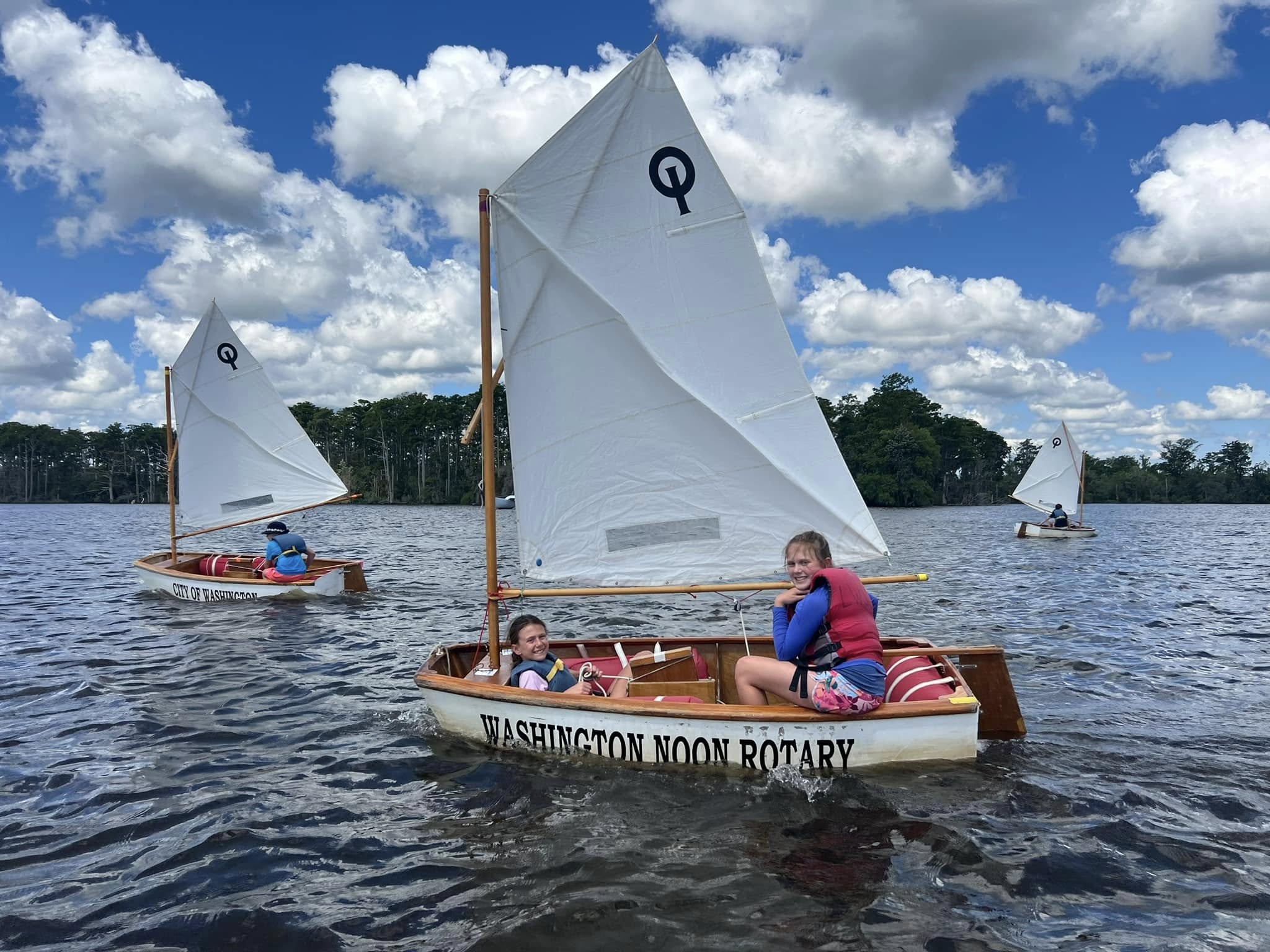
Optimist (Opti) — Beginner Boats
Designed for sailors weighing 50-120 lbs., the Optimist Dinghy has become the world standard for introductory junior trainers. Optimist sailors learn the essential steering and sail-trimming skills necessary to continue in the sportof sailing. It’s flat, stable hull provides an non-intimidating introduction to sailing; and, as young sailors progress, they can graduate to the Vanguard 420.
LOA: 7’7″ / Beam: 3’7″ / Sail Area: 35 sq. feet / Rigged Weight: 77 lbs
Vanguard 420
Vanguard developed the Club 420 in response to the growing need for a more durable, high-performance, double-handed racing dinghy that could stand up to the rigors of club and collegiate programs. Ideal for crews ranging in size from 220-310 lbs. (this is only the ideal weight if the crew weighs more or less the boat can be adjusted), the Club 420 is manageable for sailors coming out of the Optimist class and enables young sailors to learn safety, teamwork, and responsibility. The stable, forgiving hull is built tough with reinforced fiberglass, high impact bumpers, and a simple, non-tapered rig. The Vanguard 420 is simple and safe for beginning sailors and yet quick enough for more challenging adventures.
LOA: 13’9″ / Beam: 5’5″ / Sail Area: 110 sq. feet / Spinnaker Area: 95 sq. feet
Draft (board down): 3’2″ / Rigged Weight: 260 lbs